This message was preached at Sherwood Community Friends Church on Sunday, May 10, 2026. You can watch the video in full by clicking below.
OPENER
Photini, which means "the enlightened one," was the name given to a seemingly normal, slightly less-than woman after her baptism. Once she had a radical encounter with Jesus, she became a different woman. She then brought her 5 sisters and 2 sons, Victor & Joses, to know Christ for themselves. From that point on, they became avid international missionaries.
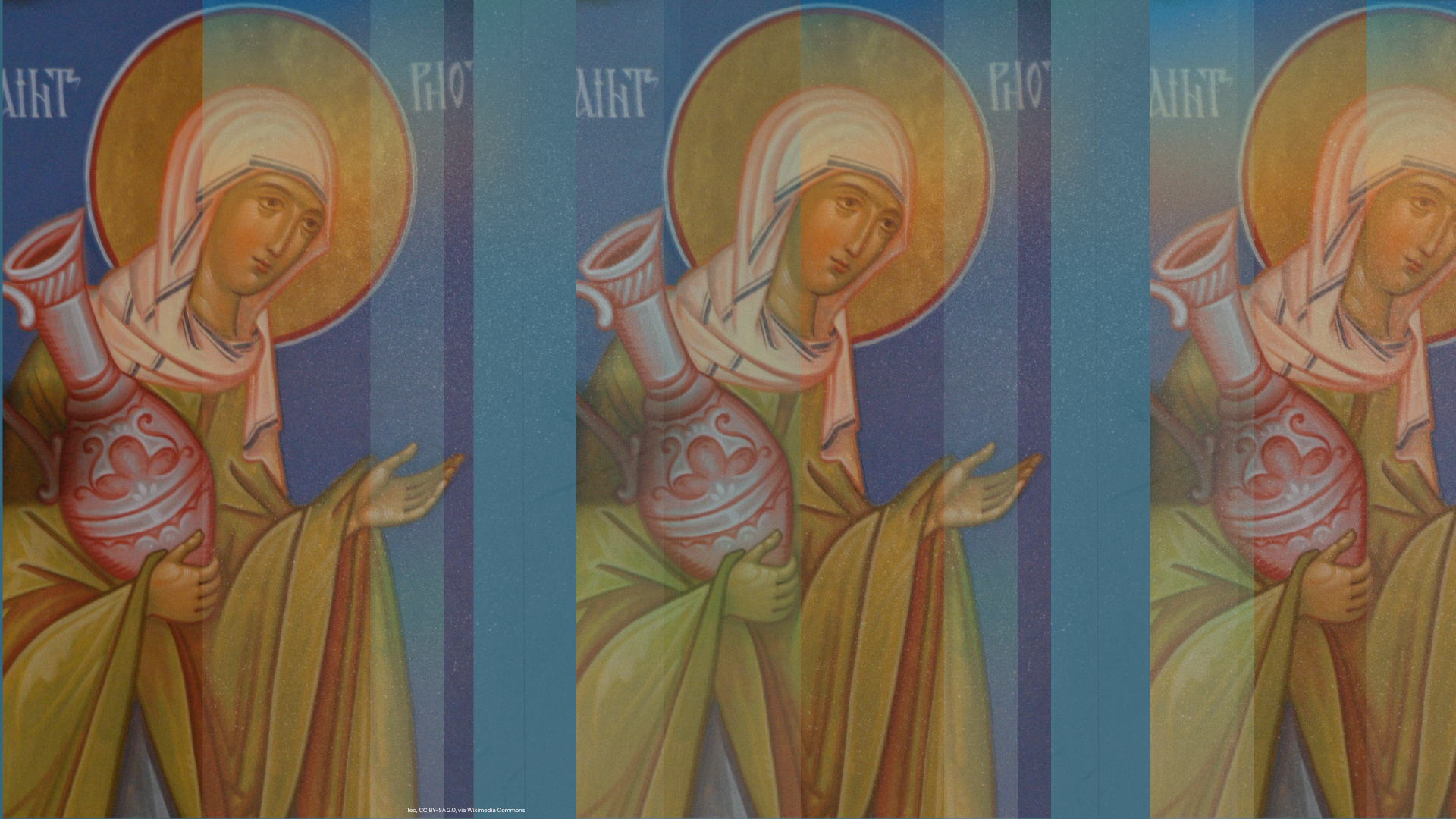
Ted, CC BY-SA 2.0 <https://creativecommons.org/licenses/by-sa/2.0>, via Wikimedia Commons, modifications mine
Photini, Joses, and the sisters spread the work of the Gospel throughout North Africa, landing in Carthage, a major city in the Roman Empire. Victor didn’t go with them. Instead, he joined the Roman army. He maintained his faith in secret, but as he rose in the ranks, he faced a dilemma. He was given orders to locate and arrest Christians as the Way continued to grow in popularity. It was seen as a threat to the Roman Empire.
Sebastian, a friend and superior to Victor who knew of his faith, told him to lie low. After some consideration, Victor couldn’t abandon his faith. After this encounter, Sebastian lost his vision and, a few days later, called for Victor. When he walked in, Sebastian said, “Christ is calling me.” Soon after his vision returned, Sebastian was baptized.
Unfortunately, Victor and Sebastian were arrested, but Christ met them in a vision, and renamed Victor Photinos, thus sharing his mother’s name. When Photini and the family heard of his imprisonment, they rushed back to Rome to encourage him. Eventually, they too, were captured and imprisoned.
Photini, or as we might call her “the woman at the well” was one of the greatest 1st-century Christian missionaries. And it all started with a seemingly random encounter one day.
JOHN’S GOAL
The story of the woman at the well is found in John 4. And as we know, with any book of the Bible, before we read from our lens - our situated reading of Western Americans in 2026 - we first want to understand the author’s intention and derive its authority from that.
I know we’ve been in Genesis mode for the majority of the year, so I’d like to take a moment to talk about the Gospel of John, the main source for our text today. John was written by John, son of Zebedee, one of the original 12 followers of Jesus. And John was written to the larger Greco-Roman world in Ephesus and beyond. This is why John will frequently explain certain customs or rituals - because his audience wasn’t familiar with them. It was also the last gospel written, written between 70 and 100 AD.
As to the overarching purpose of the book as a whole, we don’t have to guess. John tells us the purpose statement in 20:30-31:
Jesus performed many other signs in the presence of his disciples that are not written in this book. But these are written so that you may believe that Jesus is the Messiah, the Son of God, and that by believing you may have life in his name. -- John 20:30-31 (CSB)
The book of John is evangelistic. His emphasis is on the deity of Jesus all the way through, supported through the announcement of his coming by John the Baptist, the numerous miraculous signs, and Jesus’ 7 I AM statements.
Likely written after the destruction of the temple, John presents Jesus himself as the new temple and the center of worship. And for the largely Gentile audience, he’s communicating a new accessibility of worship of God for all of humanity.
With that, we now open up to John chapter 4, to the origin story of the first evangelist.
ACT I
“When Jesus learned that the Pharisees had heard he was making and baptizing more disciples than John (though Jesus himself was not baptizing, but his disciples were), he left Judea and went again to Galilee. He had to travel through Samaria; so he came to a town of Samaria called Sychar near the property that Jacob had given his son Joseph. Jacob’s well was there, and Jesus, worn out from his journey, sat down at the well. It was about noon.”
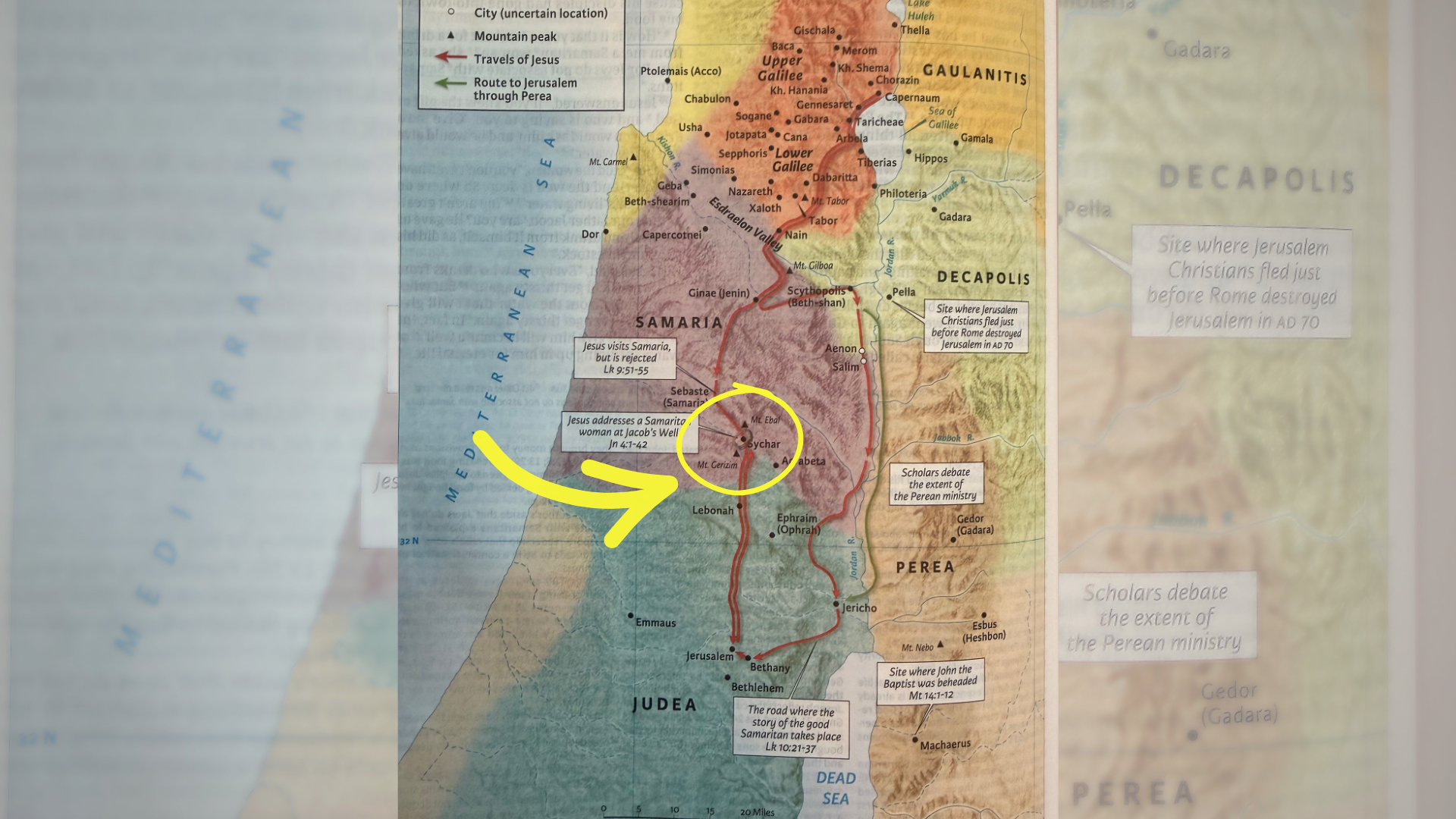
The map from my CSB Study Bible. You likely have a map in your Bible too!
This preface to our story has some important notes.
First, this geographical note is worth paying attention to. Jesus had a destination, that is Galilee. But in order to get there from where he was in Judea, he would need to go through Samaria. Why was this so bad? The Samaritans were a mixed race between Israelites who were not deported to Babylon when Jerusalem was destroyed and foreigners forcibly settled in Israel by the Babylonians. So the Jews considered the Samaritans an unclean people.
In his travels, Jesus could have taken a longer route to go around Samaria, which is argued to have been the customary path. That’s how great the tension was between the Jews and the Samaritans. But it says here that Jesus not only traveled through Samaria but also made a stop here.
Second, the time matters. It’s noon, in the heat of the day. Remember that note.
Verse 7
A woman of Samaria came to draw water.
Noon was not a normal time for women to come to the well for water. Aside from the heat, this would have been too far into the day for getting chores done and cooking, tasks that would have needed water. There’s something about her story that is unusual.
Continuing on…
“Give me a drink,” Jesus said to her, because his disciples had gone into town to buy food.
“How is it that you, a Jew, ask for a drink from me, a Samaritan woman? ” she asked him. For Jews do not associate with Samaritans.
Jesus traveling through Samaria. Not preferred but acceptable.
Jesus talking with a Samaritan woman. Unusual and questionable.
But asking for a drink? For the Jews, if Jesus would have accepted a drink of water from her, it would have also made him unclean. This would have separated him from his community and his religion. He would have to meet certain requirements to be clean again. Notice again the emphasis by the author that this was certainly an unorthodox engagement.
Ok… let’s take a breather. This idea of cultural separation and clean versus unclean is uncomfortable. It would be easy for us to slip into a narrative about racial divides and reconciliation here. And while those are important conversations, and we can have those another time, that is not what this passage is about. Remember, John’s gospel is all about naming that Jesus is the Messiah and that the reader is to worship him. Let’s keep on those set of glasses.
Verse 10.
Jesus answered, “If you knew the gift of God, and who is saying to you, ‘Give me a drink,’ you would ask him, and he would give you living water.”
“Sir,” said the woman, “you don’t even have a bucket, and the well is deep. So where do you get this ‘living water’? You aren’t greater than our father Jacob, are you? He gave us the well and drank from it himself, as did his sons and livestock.”
Jesus said, “Everyone who drinks from this water will get thirsty again. But whoever drinks from the water that I will give him will never get thirsty again. In fact, the water I will give him will become a well of water springing up in him for eternal life.”
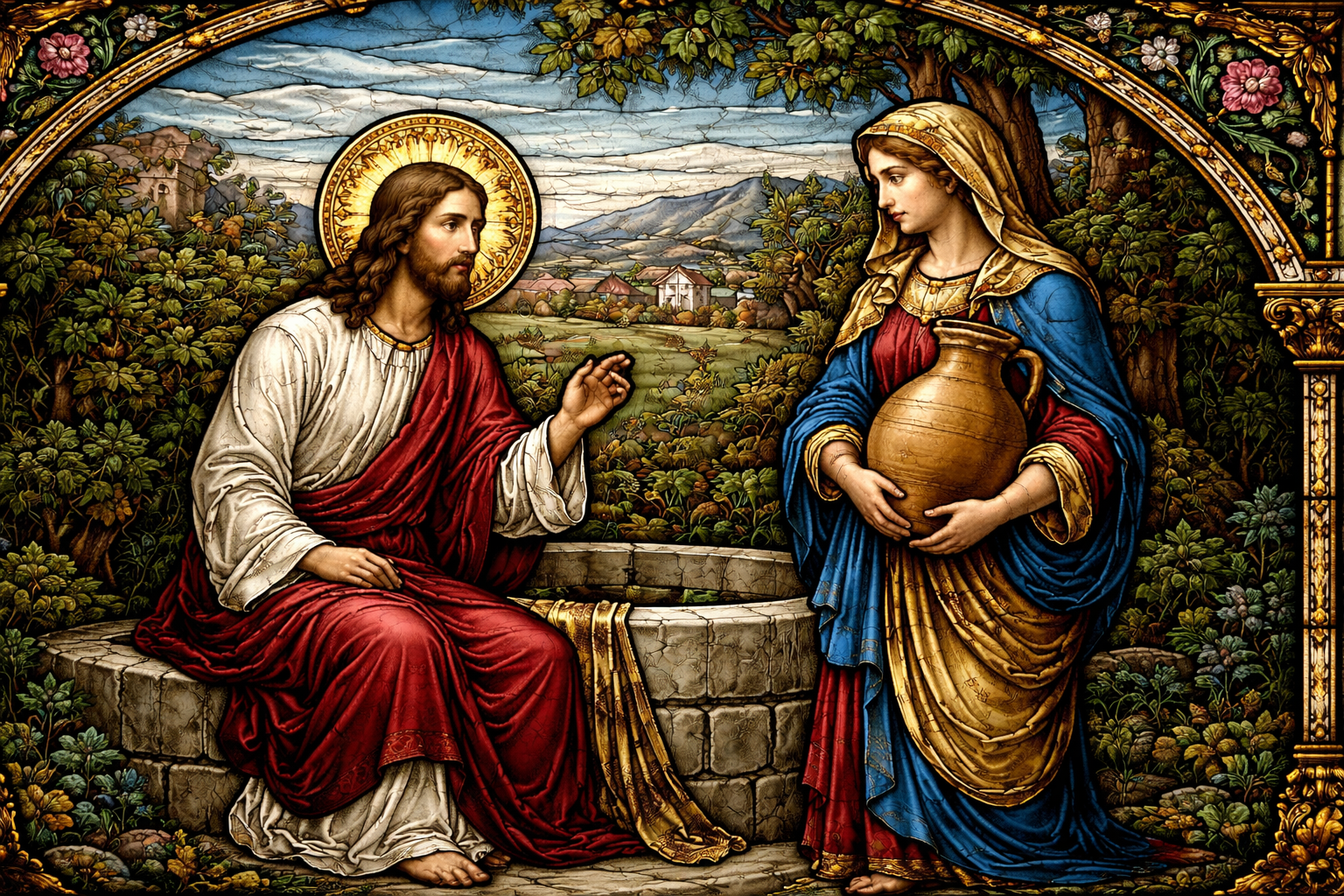
Thank you ChatGPT for this image.
Here is Jesus, standing in front of this woman. We don’t know if she was pulchritudinous or homely. We don’t know if she was wealthy or poor. We can gather she was a bit suspicious of this man. Maybe life has taught her to be guarded.
But her eyes aren’t quite open yet. She cannot see that the Messiah is standing in front of her, offering her something different, something new. She is thinking only about what is tangible - a bucket, the depth of the well. She’s thinking in her human logic.
What is this gift Jesus is offering? Living water. When the Jews spoke of living water, they meant flowing water rather than stagnant water. Living, flowing water was what was needed for ritual cleansing. A well is not a source of living, flowing, fresh water. So when Jesus is offering her this living water, he was using this imagery in his offering of eternal life access. Jesus is offering this woman water that moves, that doesn't stay stagnant.
For the woman, all she had to do was ask Jesus for what he spoke of. And in the asking, she acknowledges that what she has to pull from herself isn’t as good as what He has for her.
Verse 15.
“Sir,” the woman said to him, “give me this water so that I won’t get thirsty and come here to draw water.”
“Go call your husband,” he told her, “and come back here.”
“I don’t have a husband,” she answered. “You have correctly said, ‘I don’t have a husband,’ ” Jesus said. “For you’ve had five husbands, and the man you now have is not your husband. What you have said is true.”
Jesus has just named her shame. He named her deepest painpoint, the source of her isolation, sadness and shame. Her reason for coming to this well midday was to avoid the whispers and ridicule of the other women. The feeling of being discarded by man after man. The center she lived in was rejection.
And this is the place Jesus met her.
Not only did Jesus see her and name these things about her, but he set aside his cleanliness, his perfection to share a drink with this woman full of shame. She didn’t think she was worthy of anyone caring about her. She was skeptical of everyone. Yet here this Jew shows up and breaks through the walls she has built up.
This is the moment we all ache for. The moment when we feel seen. When that one painpoint that the world holds against us, Jesus names and sees and stays anyway. That moment changes us forever.
What’s her reaction? Well, I imagine she knew that her life would never be the same and that she has just encountered someone special.
“Sir,” the woman replied, “I see that you are a prophet. Our ancestors worshiped on this mountain, but you Jews say that the place to worship is in Jerusalem.”
Here it is! The climax of this story!
Jesus told her, “Believe me, woman, an hour is coming when you will worship the Father neither on this mountain nor in Jerusalem. You Samaritans worship what you do not know. We worship what we do know, because salvation is from the Jews. But an hour is coming, and is now here, when the true worshipers will worship the Father in Spirit and in truth. Yes, the Father wants such people to worship him. God is spirit, and those who worship him must worship in Spirit and in truth.”
The woman knows something is different about this man. Perhaps she’s recognizing this odd encounter with a Jewish man as something more. Something holy.
She tests it. Not by asking about her life or her circumstances, but she asks about worship.
In his response, Jesus communicates 3 things. Before he does, he starts off with this assertion, “Believe me” - The word is pistueo, which is more likely translated “I tell you the truth.” We’ve talked about this word before and it communicates more of a reliance, a confidence in. “This is something that you can stake your life on”, Jesus says. This is how Jesus begins with this woman, with an assertion of truth rather than a plea for belief.
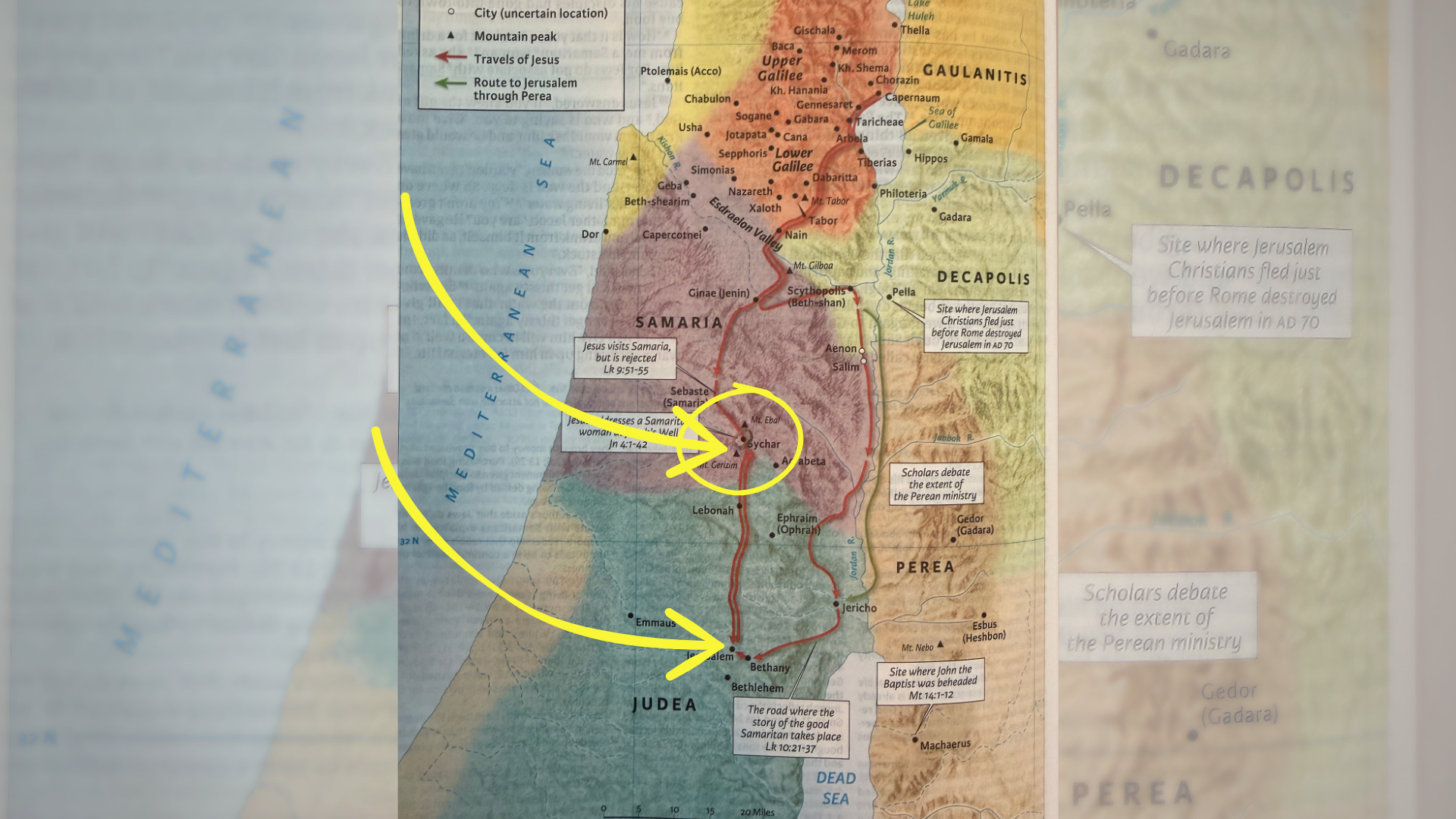
The top arrow is pointing to Mt. Gerizim. The bottom to Jerusalem. Soon, these places would be irrelevant for worship.
The first point: both the temple and the mountain will be obsolete. So, what’s the deal with this mountain? Well, this mountain refers to Mount Gerizim. The Samaritans had their own temple, rituals and traditions, even though the temple that had been there had long been destroyed. Because the Samaritans were considered unclean, they were not allowed to worship in Jerusalem with the other Jews. In addition, they had their own version of the Torah - the first 5 books of the Old Testament - and nothing else that they followed. Another point of separation. But Jesus doesn’t say the Samaritans must go through some lengthy process (in ritual or geographical distance) to worship God in Jerusalem. Instead, he says that both of them will be unnecessary to gain access to the Father through worship.
The second point: Although this is true, that all will have access to worship the Father, salvation is still coming through the Jews. The difference between the Samaritans not knowing what they worship versus the Jews knowing was only connected to the stream of revelation that had been given to the Jews, which originated with Abraham in Genesis 12. The Jews know who they worship, God who will bring the Messiah. This is not to say that all Jews will experience salvation by default, only that salvation will come from this line.
The third point: The nature of worship that would soon come is positive and more accessible. When Jesus points out that God is spirit, this was a common understanding between them. It’s the second part of that which is transformative. The word for “in truth” is alētheia - which is derived from lanthanō. This means to “go unnoticed, be unknown.” With the prefix “in”, it transforms the word to mean not hidden, not concealed, something that can be considered fact. When a hidden reality is unveiled, it’s seen for what it fully is. Jesus states the obvious way we worship, that is in Spirit, and the way we worship that is introduced with Jesus, in an unveiling of knowledge.
Summarized, Jesus says to the woman, “Here’s the truth. Soon it won’t be about that mountain or that town. You worship something you know as God. The Jews worship God knowing salvation will be delivered through them. But pretty soon, that salvation will be known through the fullness of God as spirit AND the truth, because it will be revealed to everyone.”
This is radical. And some might question why this woman? Why would Jesus give such profound and foretelling revelation to this apparently rejected and shame-filled woman instead of the religious elite or those with political influence or even his disciples?
The text doesn’t tell us why Jesus chose this well along this road in this town at this time to meet this woman.
But I do notice that she is seeking. She’s hungry to know more. Worship mattered to her. Notice that Jesus’ response is because she kept pushing in the conversation. She wasn’t afraid of dialogue. And I think Jesus knew that this woman was ready to hear.
But was she really ready? How did she take in this news?
The woman said to him, “I know that the Messiah is coming” (who is called Christ ). “When he comes, he will explain everything to us.” Jesus told her, “I, the one speaking to you, am he.”
She again responds with dialogue. She doesn’t walk away. She doesn’t go and get some religious leader because she feels out of her league. She doesn’t shrug off Jesus. She drops the M word - Messiah - into the conversation. And this is the moment of full revelation for her. The Messiah met her, a woman with deep wounds of rejection and shame, with the full revelation of the New Covenant that is coming. She thought this well was sacred because it was the well of Jacob. But in fact, this well was now holy because she met the Messiah here.
ACT II
Now, this would be a lovely story if it stopped here. The woman encounters Jesus. He reveals himself to be the Messiah. What an absolutely holy moment. She could have kept this to herself. But how many of you know that when you experience revelation, a truly divine encounter, there’s no chance that you can keep this to yourself?
Verse 27
Just then his disciples arrived, and they were amazed that he was talking with a woman. Yet no one said, “What do you want? ” or “Why are you talking with her? ” Then the woman left her water jar, went into town, and told the people, “Come, see a man who told me everything I ever did. Could this be the Messiah?” They left the town and made their way to him.
In the meantime the disciples kept urging him, “Rabbi, eat something.” But he said, “I have food to eat that you don’t know about.” The disciples said to one another, “Could someone have brought him something to eat? ”
“My food is to do the will of him who sent me and to finish his work,” Jesus told them. “Don’t you say, ‘There are still four more months, and then comes the harvest’? Listen to what I’m telling you: Open your eyes and look at the fields, because they are ready for harvest. The reaper is already receiving pay and gathering fruit for eternal life, so that the sower and reaper can rejoice together. For in this case the saying is true: ‘One sows and another reaps.’ I sent you to reap what you didn’t labor for; others have labored, and you have benefited from their labor.”
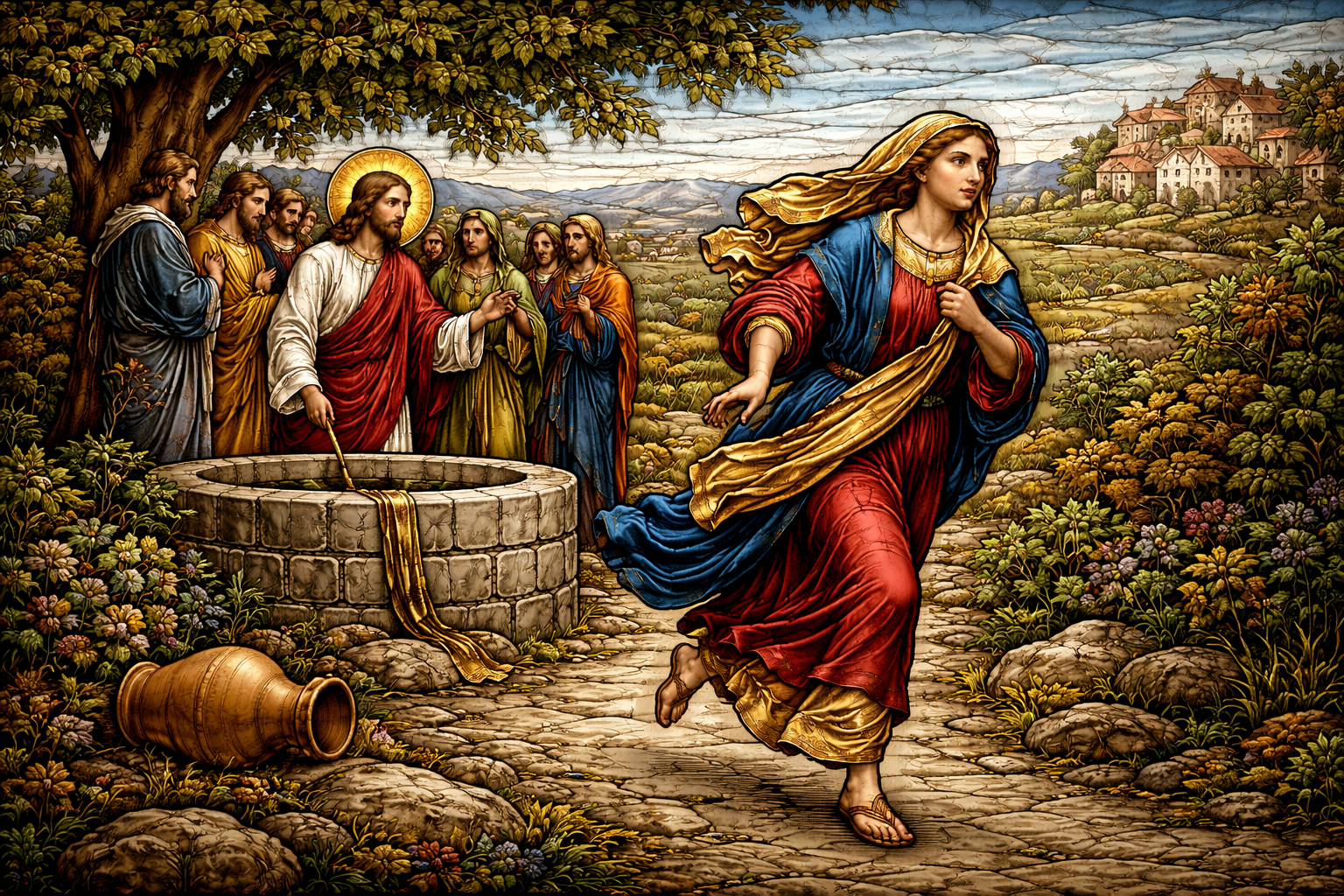
Thank you ChatGPT for this image.
This woman, who was in so much shame she would go collect her daily water in midday to avoid the chatter, she left behind her water jar and went running and shouting and making a scene.
“COME, SEE A MAN WHO TOLD ME EVERYTHING I EVER DID. COULD THIS BE THE MESSIAH?”
This gets the attention of those in the town and they follow her to Jesus.
But the disciples are distracted. They don’t think much about the woman other than just being surprised that Jesus was talking with her. They try to get him to eat. They are confused by his odd statements like “I have food to eat that you don’t know about” and “My food is to do the will of him who sent me and to finish his work.” He tells them:
Open your eyes and look at the fields, because they are ready for harvest.
There are so many people around you who are ready to be brought into the Kingdom of God! All you have to do is extend the invitation. Indeed he says the same thing to us today.
Open your eyes and look around you, for people all around you are ready to be brought into God’s kingdom.
The disciples didn’t quite get it yet, but the woman? Oh she got it. Verse 39.
Now many Samaritans from that town believed in him because of what the woman said when she testified, “He told me everything I ever did.” So when the Samaritans came to him, they asked him to stay with them, and he stayed there two days. Many more believed because of what he said. 42 And they told the woman, “We no longer believe because of what you said, since we have heard for ourselves and know that this really is the Savior of the world.” -- John 4:1-42 (CSB)
The people were drawn to Jesus because of her testimony, the first ever Christian missionary. It led them to curiosity, an invitation for Jesus to stay with them (again, radical idea!). And then, they believe for themselves. They know that Jesus really is the “Savior of the world.” Yes, even for them, the Samaritans.
CONCLUSION
Earlier, I shared about this woman, Photini, who received this name after this encounter at the well with Jesus and after her baptism. I left you on a cliffhanger though. So, what happened to Photini after she was imprisoned?
The Roman Empire under Nero tried to make an example of her and her family by making them recant their faith. Of course, they didn’t. Can you imagine… This woman who shared holy ground with Jesus at a well, who was so compelled by the revelation she received that she disregarded what the village thought about her in declaring Jesus as Messiah? There was no way she could ever go back and recant such a personal revelation.
During their imprisonment, she and her family converted many to be followers of the Way in prison. Sadly, over the next several months, each family member was tortured and killed. After they were all gone to be with Lord, Photini was the last one left. Eventually, she was killed by being thrown into a dry well. And it was there Jesus welcomed her home.
This woman, who has been considered equal to the apostles, experienced a revelation that gave her a voice that had long since been lost. This revelation was more than just about her having a personal encounter. This was an unveiling of who Jesus is. So what did she do with her voice? She declared worship and allegiance to the one and only who ever saw her. She told others about this man who told her everything that she had ever done. She declared the glory of the one who shared a drink with her one day at a well.
Her message was this: Jesus is the Messiah. Worship Him in spirit and truth.
And she understood that because Jesus is the Messiah, we spread this message to anyone and everyone who will listen, even when it cost her her very life.
CALL
I wonder how many of us keep drawing from the same well, day after day. Sure, it’s good enough. But I wonder if Jesus has been offering you living water, something new and fresh, but you have been holding that at arms length? Perhaps you are afraid of the change it will bring in your life. Or you don’t feel worthy of anything that God might want to gift you. Maybe you don’t see yourself as holy enough.
Today, you might identify with the woman at the well. You are so hungry for revelation. You are asking questions and engaging in conversation, seeking answers to know new life. And Jesus says, “Just ask and I’ll give you living water.” So it’s time for you to ask today. It’s time to set aside your shame, because Jesus already has. He’s sitting at the well with you and asking you for a drink - to share yourself with him. He’s inviting you to ask him for living water - eternal life - maybe for the first time in your life. He’s revealing himself to you as the only Messiah - the only one who can bring you into new life. It’s time to say yes.
If that’s you, just right where you are, between you and God, say yes. Say yes to his living water and his place as the one who leads your life from now on.
Others in this room might need to be challenged. You know you have experienced a revelation and unveiling of God in your life. But you’ve kept this to yourself. The voice God gave you back, you haven’t been using it. You haven’t gone shouting from your well to your town, naming Jesus as the Messiah and your Lord. He’s been asking you to take a step, share who he is in Spirit and Truth, to GO somewhere you never thought you would. It might be to teach our kids on a Sunday morning what it means to follow Jesus. It might be across the street to a neighbor’s house. It might be on a mission trip. It might be across the world. And honestly, the idea of it all - it scares you. To you, I remind you of Jesus’ words at the end of the Great Commission - “And remember, I am with you always, to the end of the age.” We never go alone.
If that’s you, be honest with God. Name the fear that’s been holding you back and ask him to take it from you. Commit yourself now to following Jesus, wherever that is going to lead you.
If you responded to either of these today, tell someone. Anyone. This isn’t so there’s some kind of record for us. No. This is shoving a foot into the enemy’s face who is going to try to convince you this moment when you said YES to Jesus didn’t happen or that you didn’t really mean it. When we bring others into our commitment, just as Photini did, it multiplies and manifests in supernatural ways.
Sources:
CSB Study Notes from my CSB Bible
John H. Walton and Kim E. Walton, The Bible Story Handbook: A Resource for Teaching 175 Stories from the Bible (Wheaton, IL: Crossway, 2010).
Spicq, Ceslas, and James D. Ernest. 1994. In Theological Lexicon of the New Testament, 1:66. Peabody, MA: Hendrickson Publishers.