God’s Sovereignty | Genesis 47-50
This message was preached at Sherwood Community Friends Church on Sunday, June 14, 2026. You can watch the video in full by clicking below.
Summary
Last week, Robert walked us through Genesis 42–46. These chapters were where twenty-plus years of pain, silence, and estrangement come crashing into one room. One the most powerful men in Egypt was once a little brother that his brothers sold into slavery. Those same brothers showed up at his doorstep, not knowing it was Joseph, asking for food. What the text revealed to us is how God had been quietly forming both Joseph and his brothers across all those years of waiting. We saw Judah’s transformation when he stood up at the critical moment and offered himself in Benjamin's place–a distinct difference from the one who devised the original plan to get rid of Joseph. We see the emotional reunification of Joseph and his father Israel. And Robert landed us on the choice of love as the response—not as a feeling, but as a costly, deliberate choice. Joseph chose love over bitterness, resentment and revenge.
Now, in the musical rendition of this story Joseph and the Amazing Technicolor Dreamcoat, the story stops with this pivotal reunification. It makes a tidy ending, doesn’t it? But there is more to the story. If you are following along in your Bibles, feel free to turn to Genesis 47.
What Comes Next
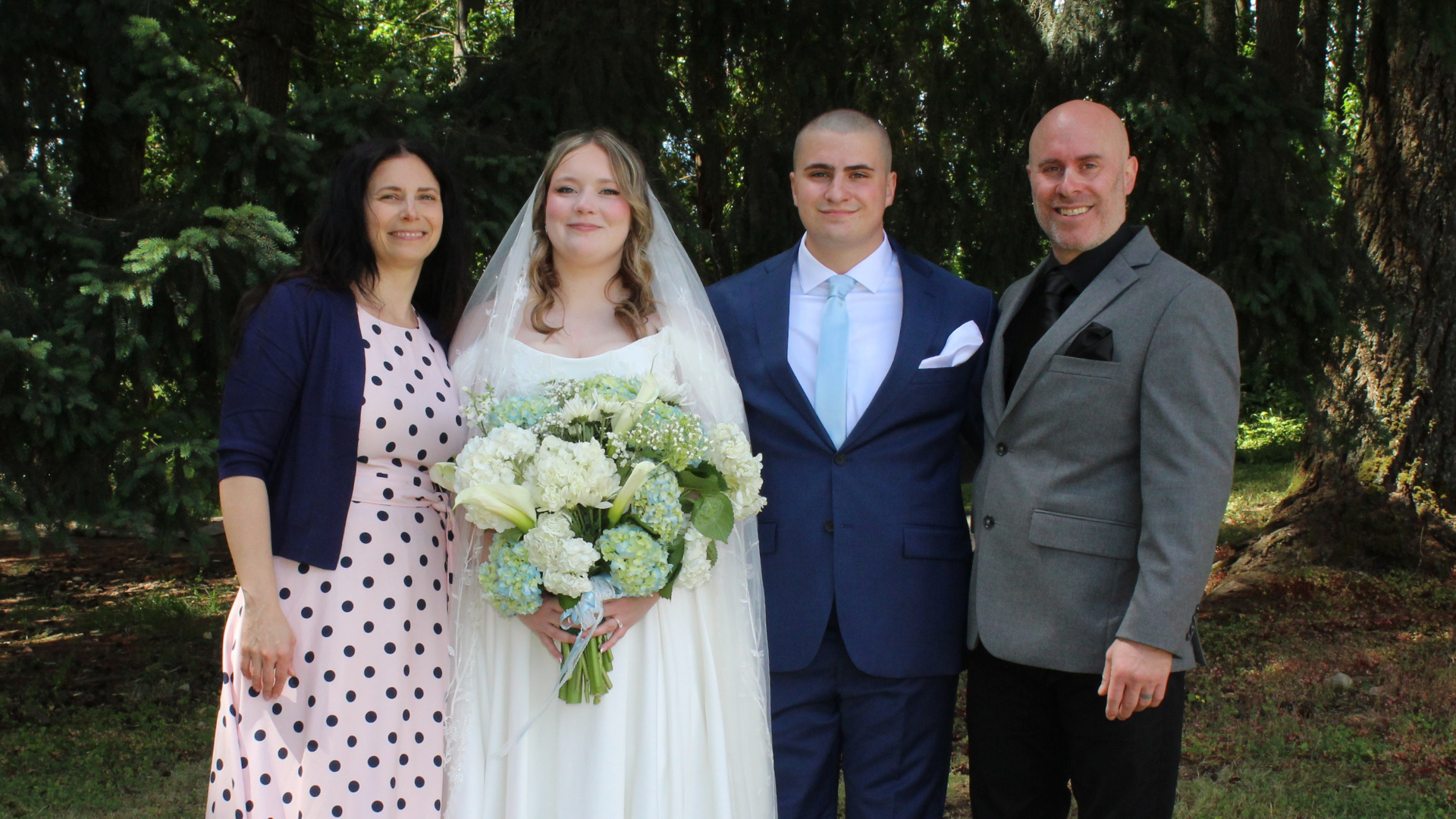
Seriously. Such a wonderful day.
On June 2nd, the first of our family arrived for the celebration of Brayden and Lily’s wedding. Over the next 7 days, all of my worlds collided. Brayden’s family, Lily’s family and our church family mingled, got to know each other, and we celebrated this new, joined life together. How many of you know that sometimes it’s a little nerve-racking anticipating our worlds colliding?
Well, I imagine this is a little bit about how Joseph felt. Jacob–whom I’ll refer to as Israel or Jacob throughout but it’s the same person–and the whole family are about to arrive in Egypt. Joseph’s worlds are about to collide. The 70 men, plus their wives and children, all make the trek with no guarantee of a place to settle. Joseph preps his father and brothers for when they are introduced to Pharaoh, which is where we begin in chapter 47.
Genesis 47:1-2 “So Joseph went and informed Pharaoh: ‘My father and my brothers with their flocks and herds and all that they own, have come from the land of Canaan and are now in the land of Goshen.’ He took five of his brothers and presented them to Pharaoh.” CSB
As the interaction goes, it is exactly as Joseph had told them. Pharoah asked their occupation and the brothers responded as they were instructed, requesting to settle in the land of Goshen.
Pharaoh, the most powerful person in the known world, responds in kind.
“Then Pharaoh said to Joseph, ‘ Now that your father and brothers have come to you, the land of Egypt is open before you; settle your father and brothers in the best part of the land. They can live in the land of Goshen. If you know of any capable men among them, put them in charge of my livestock.” Genesis 47:5-6, CSB
Can you feel the grace oozing from this story? The mistake of these brothers is overshadowed by the generosity of Pharaoh. And that generosity is mediated through Joseph, the very one they had betrayed so long ago.
Then, in what I imagine to be a climactic moment, Joseph brings his father Jacob to meet Pharaoh.
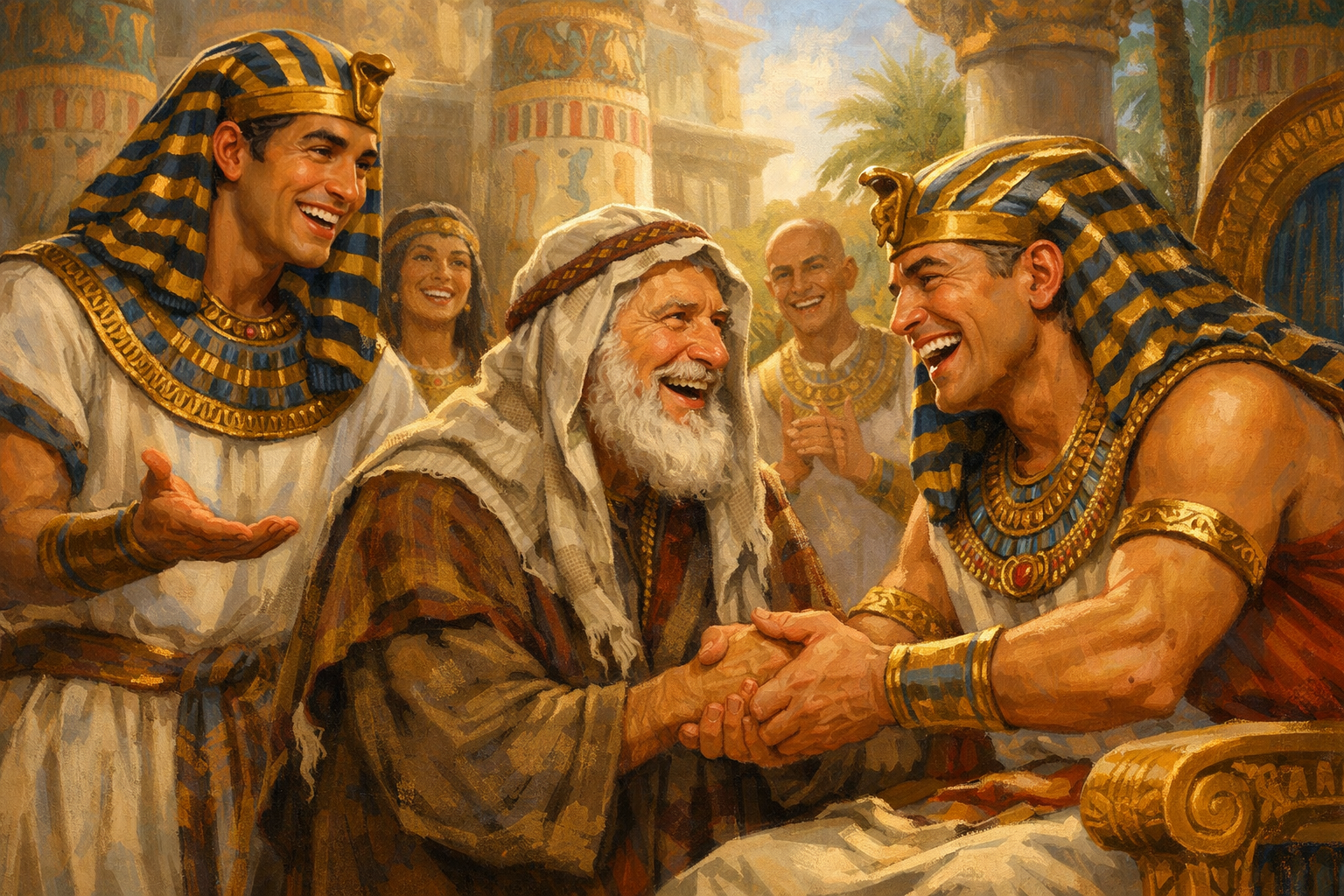
Worlds colliding. Thank you ChatGPT for this image.
“Joseph then brought his father Jacob and presented him to Pharaoh, and Jacob blessed Pharaoh. Pharaoh said to Jacob, ‘How many years have you lived?’ Jacob said to Pharaoh, ‘My pilgrimage has lasted 130 years. My years have been few and hard, and they have not reached the years of my ancestors during their pilgrimages.’ So Jacob blessed Pharaoh and departed from Pharaoh’s presence.” Genesis 47:7-10, CSB
The one who gave Joseph life, gifts, and favor meets the one who gave Joseph freedom, power, and opportunity. Perhaps the two most important people in forming who Joseph is, his character, his wisdom meet for the first time. And their graciousness to each other gives insight into the man that Joseph has become.
In this meeting, we see a reversal of blessing. By power and stature, Pharaoh is the greater of the two. But the author is specific to note not only one blessing by Jacob, the lesser of the two men by status, but also a second blessing bestowed upon Pharaoh.
After this interaction, Joseph’s family settles in the land of Egypt, as approved by Pharaoh. But note that Joseph doesn’t just wash his hands of his family. The love that Robert pointed out last week continues to be poured out lavishly.
“And Joseph provided his father, his brothers, and all his father’s family with food for their dependents.” Genesis 47:12, CSB
No hint of resentment or bitterness. No treatment of them as less than. Joseph shows only love through provision of food–a scarce commodity in this famine.
Joseph’s Power
A brief word about Genesis 47:13-26.
As the story progresses, we see the power and authority of Joseph through the implementation of economic policies and problem solving. Keep in mind, there is a devastating famine in the land. I have never lived through a famine. I can only imagine the struggle. There are no labs to grow food. There’s no airplanes to ship in supplies. This is a matter of survival.
What this recounting of the Egyptian policy is not is a model to emulate. Joseph’s plan focuses on redistribution rather than sharing or generosity. There is no mention of God condemning or condoning this methodology. The text is simply informing the reader of what happened and, right or wrong, God worked through it to continue to sustain Israel and his sons.
Israel’s Final Days
That said, we move into Israel’s final days.
Finally, Israel and his family settles in the land of Egypt, they acquire property and, in verse 47:27, it says they “became fruitful and very numerous.”
Where did we begin in Genesis?
Genesis 1:28a “God blessed them, and God said to them, ‘Be fruitful, multiply, fill the earth, and subdue it.”
And, when God met Noah as they came off the ark, what is the command he and his family were given?
Genesis 9:1a “Be fruitful and multiply and fill the earth.” CSB
Then God encountered a righteous man named Abram and he makes a covenant with him, despite their inability to have children.
Genesis 12:2 “I will make you into a great nation, I will bless you, I will make your name great, and you will be a blessing.”
And later, God followed it up with
Genesis 15:5 “Look at the sky and count the stars, if you are able to count them.” Then he said to him, “Your offspring will be that numerous.” CSB
In 2 weeks, Robert will give us an overarching summary of Genesis, this book we have broken down and studied so deeply over the last 6 months. No doubt, he will walk us through each of the obstacles that have gotten in the way of the designed order God gave us. Yet, now, as we near the end of this book, we see God’s thread of provision. The Israelites are growing in number and becoming prosperous, even in the time of famine.
Israel is now nearing the end of his days. As was customary from what we have already seen throughout the text of Genesis, this is the time for the patriarchal blessing from father to sons, and he begins with Joseph’s sons.
I imagine Jacob feels deep sorrow for the time he missed with Joseph that was taken from him. Yet, he is grateful for the gift not only to see Joseph but also to see his sons. He declares that Ephraim and Manasseh are to be considered his descendants as much as any of his other sons, and then he blesses them. But the blessing in 48:13-20 seems a bit confusing.
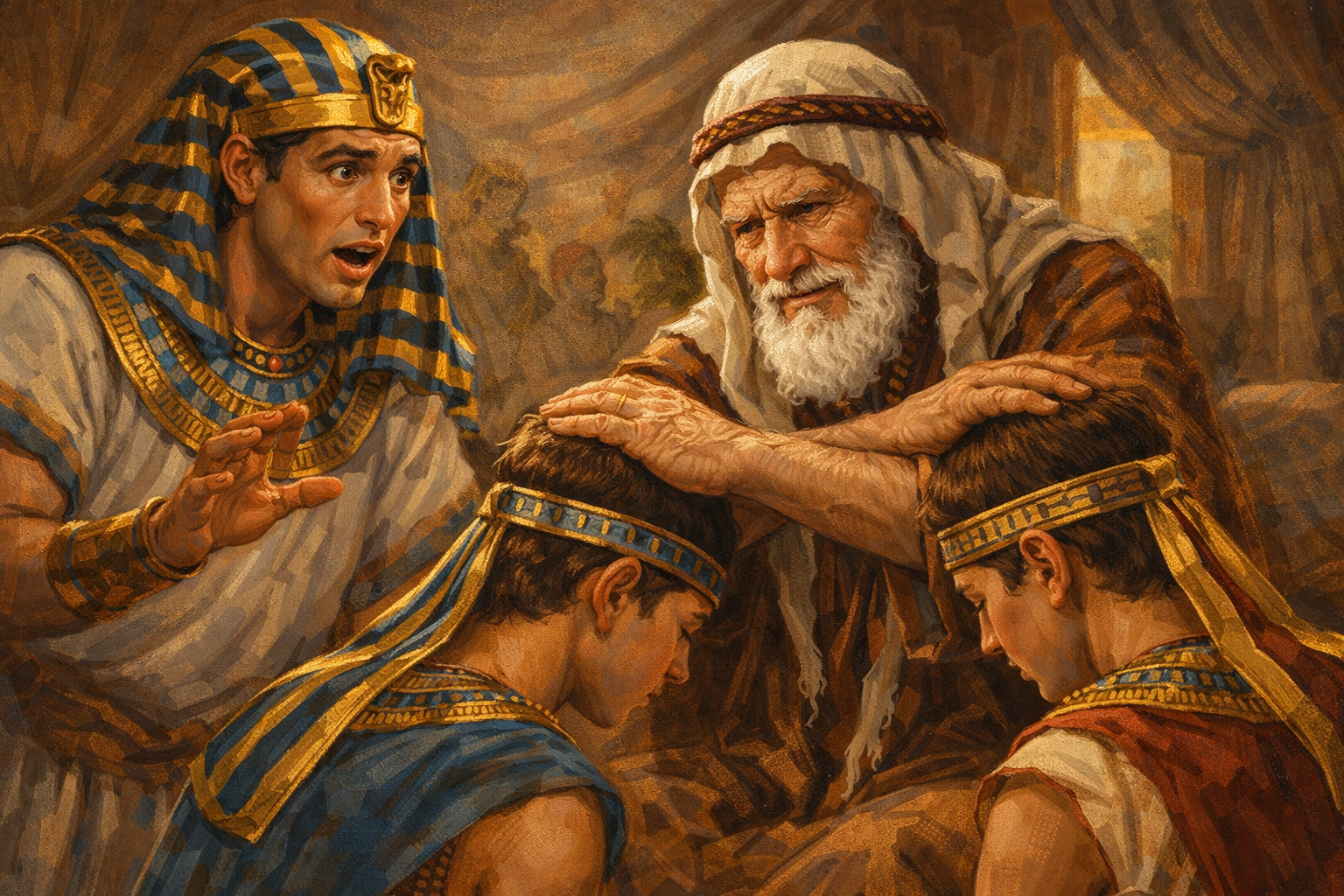
Reverse blessing. Thank you ChatGPT for this image.
We gather that Jacob is an old man, as noted several times by now. Joseph puts his sons in front of Israel, with Manasseh, the older one, to be blessed by Israel’s right hand, which was customary. But Israel, switches his hands, crossing his arms so that the younger Ephraim receives the larger blessing. Joseph tries to correct him.
Genesis 48:18-20 “But his father refused and said, ‘I know, my son, I know! He too will become a tribe, and he too will be great; nevertheless, his younger brother will be greater than he, and his offspring will become a populous nation.’ So he blessed them that day, putting Ephraim before Manasseh when he said, ‘The nation Israel will invoke blessings by you, saying “May God make you like Ephraim and Manasseh.”’” CSB
This is not the first time we have seen this role reversal. The younger Jacob himself received the blessing of his father Isaac, albeit by deception. And Esau traded his birthright blessing to Jacob for a bowl of soup. But even the covenantal blessing was given to Jacob, and that was only God’s to give. Remember back in Genesis 28? Jacob has just fled because he usurped his brother’s blessing. He saw a vision of a stairway with God’s angels and the Lord appeared to him, saying
“I am the Lord, the God of your father Abraham and the God of Isaac. I will give you and your offspring the land on which you are lying. Your offspring will be like the dust of the earth, and you will spread out toward the west, the east, the north, and the south. All the peoples on earth will be blessed through you and your offspring. Look, I am with you and will watch over you wherever you go. I will bring you back to this land, for I will not leave you until I have done what I have promised to you.” Genesis 28:13b-15, CSB
You see, Jacob knew more than anyone that blessing is not dependent on birth order, status, or even if you do what is right or not. When he received that covenantal confirmation, he was not worthy of it. Yet that’s what God does. That is his grace! He gives to us when we are in our least worthy moments of our lives. That is his sovereignty.
After his time with Ephraim and Manasseh, Jacob takes the time to speak over each of his children. The word “blessing” is too generous. Some of these feel more like curses! Some feel more neutral. But the one I’d like for us to take a little closer of a look at is Judah in 49:8-12:
Judah, your brothers will praise you. Your hand will be on the necks of your enemies; your father’s sons will bow down to you. Judah is a young lion—my son, you return from the kill. He crouches; he lies down like a lion or a lioness—who dares to rouse him? The scepter will not depart from Judah or the staff from between his feet until he whose right it is comes and the obedience of the peoples belongs to him. He ties his donkey to a vine, and the colt of his donkey to the choice vine. He washes his clothes in wine and his robes in the blood of grapes. His eyes are darker than wine, and his teeth are whiter than milk. Ge 49:8–12. CSB
Judah’s blessing length is only second to Joseph’s. We see this mention to the scepter and the staff, symbols of kingship in ancient Israel. In verse 10, when it says
The scepter will not depart from Judah or the staff from between his feet until he whose right it is comes and the obedience of the peoples belongs to him.
Has long been understood for thousands of years as messianic references. For us, this is a prophecy of Jesus’s coming, who did come from the line of Judah.
One would argue that, until the moment in the palace where he trades his life for that of Benjamin’s, Judah has been one of the biggest antagonists of this story! Yet, his blessing rivals that of Joseph’s and his sons. In our right vs. wrong culture, it is hard to understand why the lineage Joseph would not be the one to carry the covenant through to Jesus. After all, Joseph was the innocent one! But again, the sovereignty of God doesn’t look for all the checkboxes completed or the right pedigree. The sovereignty of God is independent of any external control. Does this mean that God is wrathful or vengeful? What stops him from pouring down anger?
Paul talks about this to the Romans in chapter 8, starting in verse 28.
“We know that all things work together for the good of those who love God, who are called according to his purpose. For those he foreknew he also predestined to be conformed to the image of his Son, so that he would be the firstborn among many brothers and sisters. And those he predestined, he also called; and those he called, he also justified; and those he justified, he also glorified.” Romans 8:28-30, CSB
God is good. And he can’t help to pour out that goodness on his children who are those of us who have made that decision to be conformed to the image of Christ.
After Jacob has blessed his sons and his soul is at peace, he is gathered to his people in his final breath.
Joseph weeps. There is a time of mourning. An appropriate burial is arranged so that this man can be buried with those whom he survived up to this point. When they arrive, there is more lamenting and weeping. And they honored their father’s wishes.
“So Jacob’s sons did for him what he had commanded them. They carried him to the land of Canaan and buried him in the cave at Machpelah in the field near Mamre, which Abraham had purchased as burial property from Ephron the Hethite.” Genesis 50:12-13, CSB
Fear Returns
But now the brothers panic.
When Joseph’s brothers saw that their father was dead, they said to one another, “If Joseph is holding a grudge against us, he will certainly repay us for all the suffering we caused him. So they sent this message to Joseph, “Before he died your father gave a command: ‘Say this to Joseph: Please forgive your brothers’ transgression and their sin—the suffering they caused you.’ Therefore, please forgive the transgression of the servants of the God of your father.” Joseph wept when their message came to him. His brothers also came to him, bowed down before him, and said, “We are your slaves!” Genesis 50:15-18, CSB
Even after the reunion, after years in Egypt together, after all the evidence, care, provision, land, opportunity, they still weren't sure about where Joseph stood. They even go so far as to fabricate a message from their dead father asking Joseph to forgive them.
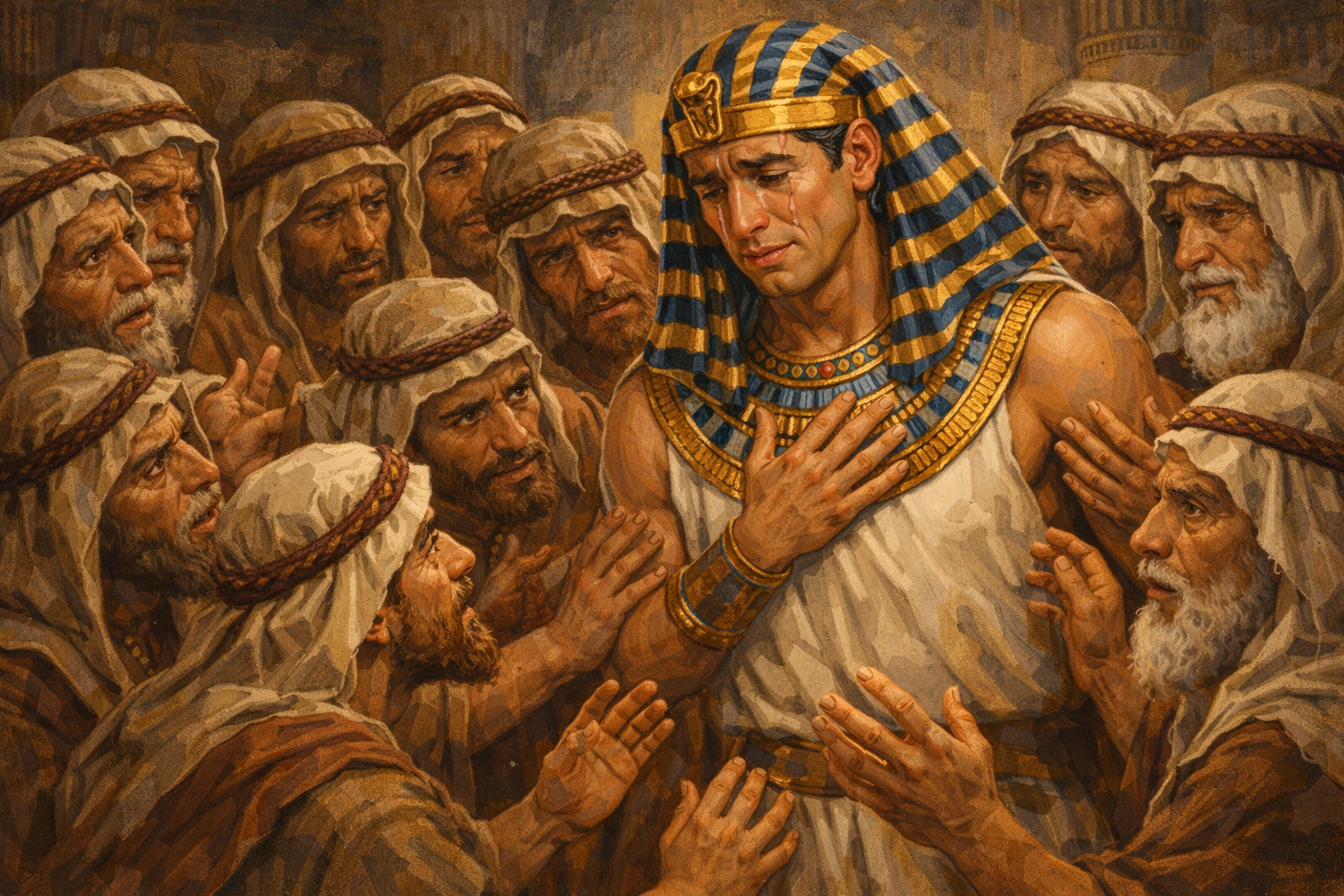
Joseph’s sadness. Thank you ChatGPT for this image.
And here we see that Joseph weeps again. All Joseph has longed for was his family. His tears held deep emotion. The trauma he endured throughout his life that he thought had come to an end just came up and took hold of his heart. They questioned his love for them, yet all he wanted, all he ever wanted from the time he was an overeager boy was their love and acceptance of who he was.
“But Joseph said to them, “Don’t be afraid. Am I in the place of God? You planned evil against me; God planned it for good to bring about the present result—the survival of many people. Therefore don’t be afraid. I will take care of you and your children.” And he comforted them and spoke kindly to them.” Genesis 50:19-21, CSB
Joseph didn’t just pacify them to make them feel better. He absolutely named their intention. It was evil. They wanted to do away with Joseph, and he knew it. But he named the bigger arch here: yes, the sovereignty of God.
Joseph was wise enough to recognize that if he had never been sold into slavery, he never would have ended up in Potipher’s house. If he had not been in that house, he wouldn’t have been falsely accused of sexual assault, which landed him in prison. If he had not been in that prison, he wouldn’t have spoken up to the baker and the cupbearer about their dreams. If he had never interpreted those dreams, he never would have been brought to Pharaoh. And, aside from his own rise to power, it’s possible the whole land of Egypt may have experienced massive devastation from a seven-year famine.
Would I be as gracious as Joseph? Admittedly, probably not. Resentment and bitterness is something that I must wrestle with frequently. But God is doing a work in me. I imagine that, along Joseph’s journey, he had his own moments with God that brought him to the recognition that he was not the hero. Joseph was not God. And when it mattered most, he named this truth by the asking of this one question to his brothers:
Am I in the place of God?
Joseph knew that God was the only hero in that moment.
CONCLUSION
Joseph lived to 110 years and he was fortunate enough to meet his grandchildren. At the end of his days, he declares to his brothers:
“I am about to die, but God will certainly come to your aid and bring you up from this land to the land he swore to give to Abraham, Isaac, and Jacob.” So Joseph made the sons of Israel take an oath: “When God comes to your aid, you are to carry my bones up from here.” Genesis 50:24b-25, CSB
In his final words, we know that Joseph knew the future of his brothers was out of his hands too. He knew it was bigger than him. Joseph was never able to return to his homeland while he had breath in his lungs. Instead, his bones remained in a box in Egypt for 400 years, while his people became enslaved under the new Pharaoh who forgot the legacy of Joseph. When God set his people free through the Red Sea, those bones wandered with them for 40 years in the wilderness. Then, finally when they take the Promised Land it says this in Joshua 24:32:
Joseph’s bones, which the Israelites had brought up from Egypt, were buried at Shechem in the parcel of land Jacob had purchased from the sons of Hamor, Shechem’s father, for a hundred pieces of silver. It was an inheritance for Joseph’s descendants.” CSB
This year, Sherwood Community Friends Church is 138 years old. This church is older than any one of us, and not one of us carries it forward. The only hero who builds our family, sustains us and moves us forward in our mission to bring more to know God through our words and deeds is God himself.
And while we can’t control God’s moves, He does move in response to us! He moves as we move. He moves as we pray. And he moves when we don’t move, or we don’t pray.
He’s given us free will to choose his sovereignty or our illusion of control. But to be clear, God ALWAYS moves according to HIS purposes. And his purposes are good and faithful and loving.
Whatever you are carrying right now–whatever looks like it’s dead, whatever you feel like you are still waiting on, whatever is unresolved–God sees you carrying it faithfully. God doesn’t forget you but he doesn’t want you to carry that burden any longer. Before you leave today, submit it to Him. Name the bones you carry and lay them rest. The Israelites didn’t lay down Joseph’s bones until they reached the Promised Land, their place of promised rest. BUT Jesus IS the Promise and he’s already arrived and extending to you rest. You can lay those bones to rest and trust that God will bring it to the best possible resolution, in his good and perfect timing.
The call to us today isn’t to understand God’s sovereignty. I’m not sure we will ever be able to fully grasp this on this side of eternity. Our call is to be faithful within God’s sovereignty. The question is not "what is God doing?" or “why is this happening?” Instead, it’s "will I be faithful?"
God, help us to be faithful and submit ourselves to your sovereignty. Amen